005 Observation
10 June 2026
WARSAW AND THE POST-SOVIET SKY
Warsaw rarely comes up when people talk about Europe's major aviation hubs. The conversation usually circles back to the same names: Frankfurt, London, Paris, Amsterdam. These are the places where the continent's air traffic converges. Warsaw is often treated as peripheral.
Which makes it easy to miss what LOT Polish Airlines has been quietly building.
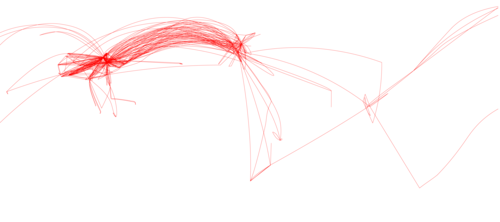
Pull up the airline's route map and something unusual appears. From Warsaw, you can fly to Tallinn, Riga, and Vilnius. To Tbilisi, Yerevan, and Baku. To Astana, Almaty, and Tashkent. One connection places travelers deep inside a geography that many larger European carriers either overlook or serve only indirectly. For passengers traveling between North America, Western Europe, and the Caucasus or Central Asia, Warsaw often becomes the most logical way through.
This didn't happen by accident. Warsaw occupies a particular position on the map: far enough east that the former Soviet republics are not a distant detour, yet close enough to Western Europe to function as a bridge between the two. Rather than competing directly with Frankfurt for the same traffic, LOT built a different kind of network.
The destinations tell the story. From the Baltics to the foothills of the Tian Shan Mountains, they trace an arc across much of the former Soviet space. Decades after the Soviet Union's collapse, the region remains surprisingly fragmented from an aviation perspective. Warsaw helps stitch parts of it back together.
Inside Star Alliance, that role becomes even more significant. A connection through Warsaw is not simply a connection to Poland. It is a connection into a global network.
None of this fits the usual story about European aviation. But perhaps that's the point. Warsaw built something useful precisely because it wasn't trying to be Frankfurt.